Organizing principles in information architecture
By UXbeam, information architecture tools and services since 2021 · Updated September 3, 2026
An organizing principle is the rule an information architecture uses to decide what belongs together. Topic, task, audience, object, workflow stage and life event are all organizing principles. The same content can support several plausible principles, each producing a materially different structure.
Many IA decisions happen after a principle is already implicit. The debate becomes where items belong inside an assumed scheme. Sometimes the more consequential question comes earlier: should a government service be organized by department, task or life event? Should a work-management product be organized around objects, goals or workflow stages? Those choices can change what people experience as belonging together before a sitemap exists.
Sometimes the organizing principle is itself the design decision you need to investigate before a sitemap is meaningful.
The rule that decides what belongs together
Louis Rosenfeld and Peter Morville described the established organization schemes for the web: topic, task, audience and metaphor, alongside hybrids that combine more than one schemeRosenfeld & MorvilleO'Reilly MediaInformation Architecture for the World Wide Web. Practice has added more. Each principle is a different rule for deciding what belongs together, and each asks a different question of the same content:
| Organizing principle | The rule asks | Example labels |
|---|---|---|
| Topic / domain | What is this about? | Housing, Education, Billing |
| Task / goal | What is someone trying to do? | Find, Apply, Compare, Configure |
| Audience | Who is it for? | Parents, Managers, Contributors |
| Object / entity | What kind of thing is it? | Projects, People, Reports, Devices |
| Life event / context | What is happening in someone's life? | Moving, Starting a business, Having a baby |
| Workflow stage | Where in the process does it sit? | Setup, Execute, Monitor, Review |
| Location | Where does it happen? | Home, Vehicle, Office, Region |
No principle is correct by default. A billing feature can sit in a topic-based information architecture under Billing, in a task-based information architecture under Pay an invoice, and in a life-event structure under Moving in. Which rule fits a domain depends on how the people using it think about it, and that can be studied rather than assumed.
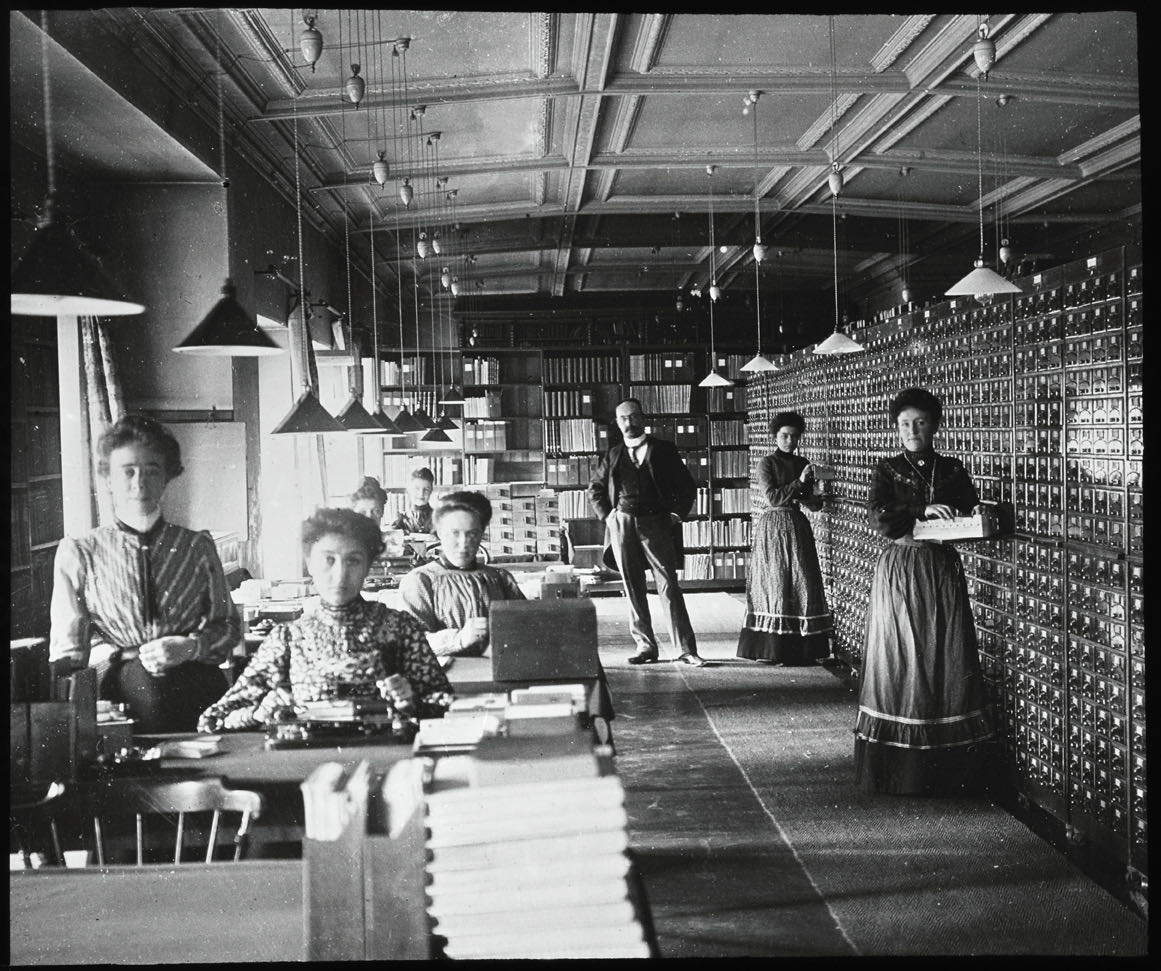
Long before digital information architecture, large information systems still required an explicit answer to the same underlying question: by what rule should things be classified and placed together?
Brussels · c. 1900
Why people organize the same domain differently
How people categorize the same things can change with their goals, expertise, and situation.
A goal can create a category. In Barsalou's studies of ad hoc categories, people produced coherent categories such as things to sell at a garage sale: items that need not share a taxonomic relationship but belong together because they serve one goalBarsalouMemory & CognitionAd hoc categories.
Expertise changes which relationships count. When Boster and Johnson asked commercial fishermen and novices to judge the similarity of the same fish, novices relied on form alone and actually came closer to the scientific classification. The fishermen's judgments also reflected function: how the fish behave, and how they are caught and usedBoster & JohnsonAmerican AnthropologistForm or Function: A Comparison of Expert and Novice Judgments of Similarity Among Fish.
What can influence the organizing principle?
For IA, competing organizing principles can therefore reflect different ways of understanding or using the same domain.
What an organizing principle can change beyond navigation
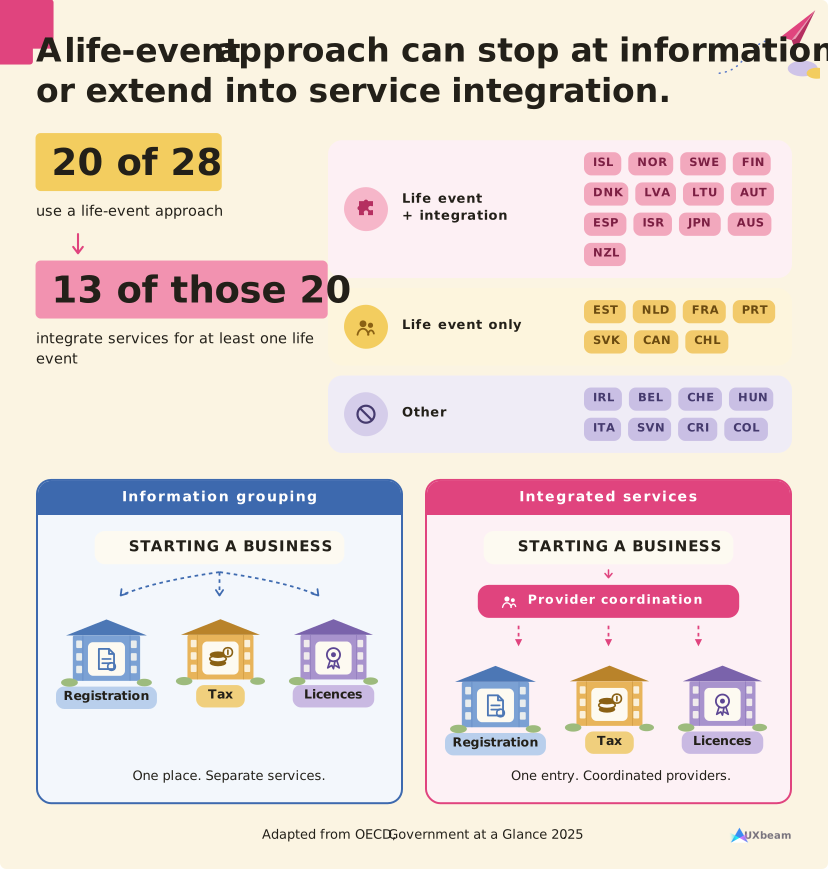
An organizing principle can change more than navigation. Victoria describes its public content as organized using a life-events approach, informed by how people experience information and services rather than by departmentvic.gov.auVictorian GovernmentUse a life events approach for digital content. That approach can expose gaps between services, journeys that break across organizational boundaries, and opportunities to join services that were previously separate.
The OECD's 2025 survey shows how this plays out across 28 countriesOECDOECDGovernment at a Glance 2025.
How card sorting exposes competing principles
Card sorting can be designed to investigate this choice. Participants group the same cards and name their own categories. UXbeam detects mental models from similarities in how the cards were placed; the category names and their contents can then reveal which organizing principle each mental model is using.
For this kind of study, the card set is deliberately constructed so several competing principles recur across the set. Participants still complete an ordinary open card sort, but the analysis can ask a question one level above individual placement: what are participants organizing this domain around?

When to investigate the principle before the sitemap
A conventional card sort answers where items belong inside an assumed scheme. Investigating the principle first is worth considering when:
- several plausible category systems all seem defensible
- stakeholders disagree because each is optimizing for a different classification rule
- the service spans several departments or teams
- different audiences may think about the same domain differently
- the product's primary model is unsettled: it is not yet clear what the main units should be
- a sitemap feels premature because the more basic question is still open: organized around what?
The workflow is the same as any UXbeam card sort. The organizing-principle analysis attaches to the mental models the sort produces:

Worked example: Card sorting government services: topic or task? A 20-card open sort in which topic and task organizing principles competed, with Mental Model Detection and organizing-principle analysis shown in full.
See also
- What a redesign deletes · four documented cases, from Sonos to WordPress, of structural change invalidating what users had already learned.
Sources
- Louis Rosenfeld & Peter Morville, Information Architecture for the World Wide Web, O'Reilly Media.
Organization schemes include topic, task, audience, metaphor and hybrids. - Lawrence W. Barsalou, “Ad hoc categories,” Memory & Cognition, 1983.
People construct coherent categories around goals, such as things to sell at a garage sale. - James S. Boster & Jeffrey C. Johnson, “Form or Function: A Comparison of Expert and Novice Judgments of Similarity Among Fish,” American Anthropologist, 1989.
Novices judged the same fish by form alone, coming closer to the scientific classification; expert fishermen's judgments also reflected function. - Victorian Government, “Use a life events approach for digital content.”
Life-event organization informed by how people experience information and services rather than by department. - OECD, Government at a Glance 2025, “Seamless and accessible public administrative services.”
Life-event adoption in 20 of 28 surveyed countries, with 13 beginning to integrate services for at least one life event.