Free card sorting tool
Discover where the parts of your product belong.
See how participants group your content, turn those groupings into an editable sitemap, and test the structure.

A card sorting tool for...
-
Designing a new navigation
You’ve collected the features, pages or topics that need to be included. Use card sorting to decide how they should be grouped and what those groups should be called.
-
Merging two structures
Two products, sections or navigation systems now need to work together. Use card sorting to see which items participants group together and where the old structures should change.
-
Comparing competing structures
Design has one version, product has another, the client has a third. Put the same items in front of participants and see how they actually group them.
Card sorting in action
-
1 · Your items
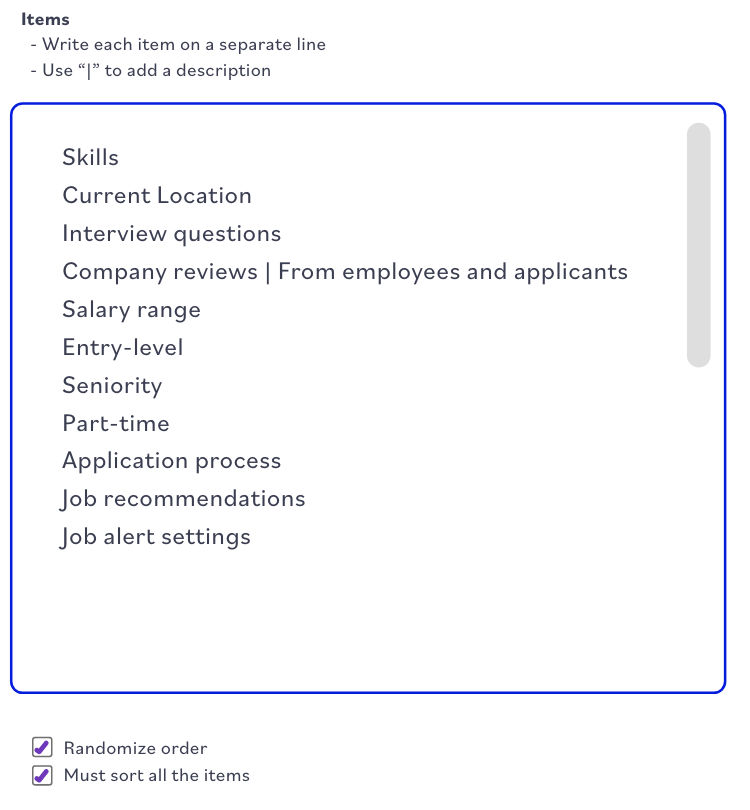
Features, pages, content.
-
2 · Participants group them
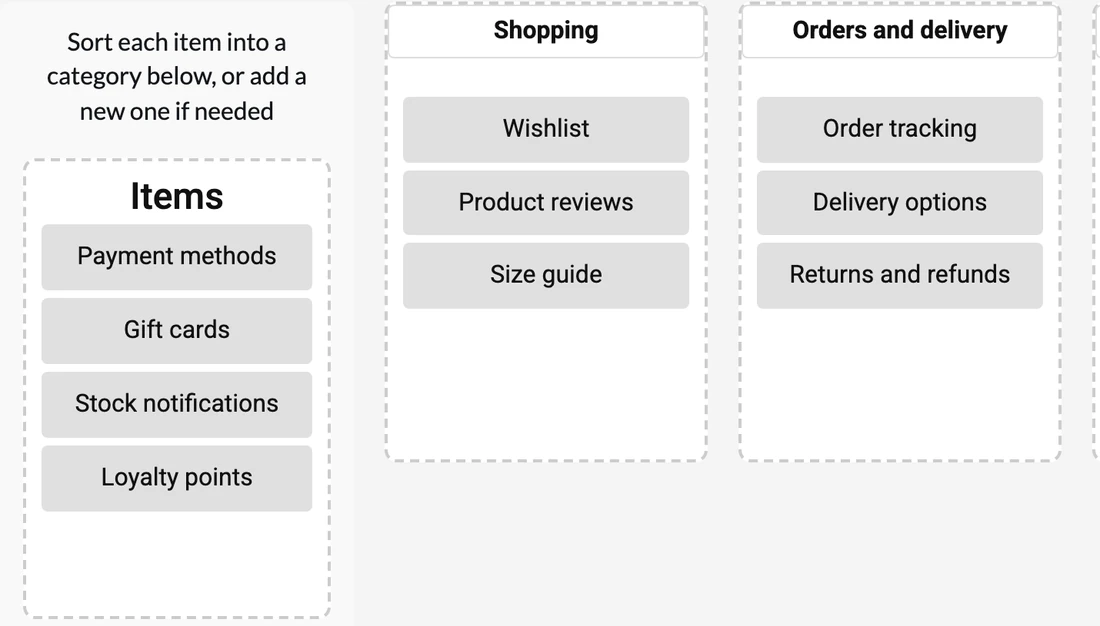
Into their own categories, into yours, or into both.
-
3 · The patterns come back
Grouped, named, and counted.
One page, two minutes, and your card sort is ready to run.
Choose an open, closed or hybrid card sort, and add an optional explanation to any item that may need more context.
See the structures participants create
See which items reliably belong together, which labels participants use for those groups, and which items split across several groups or never find a clear home.
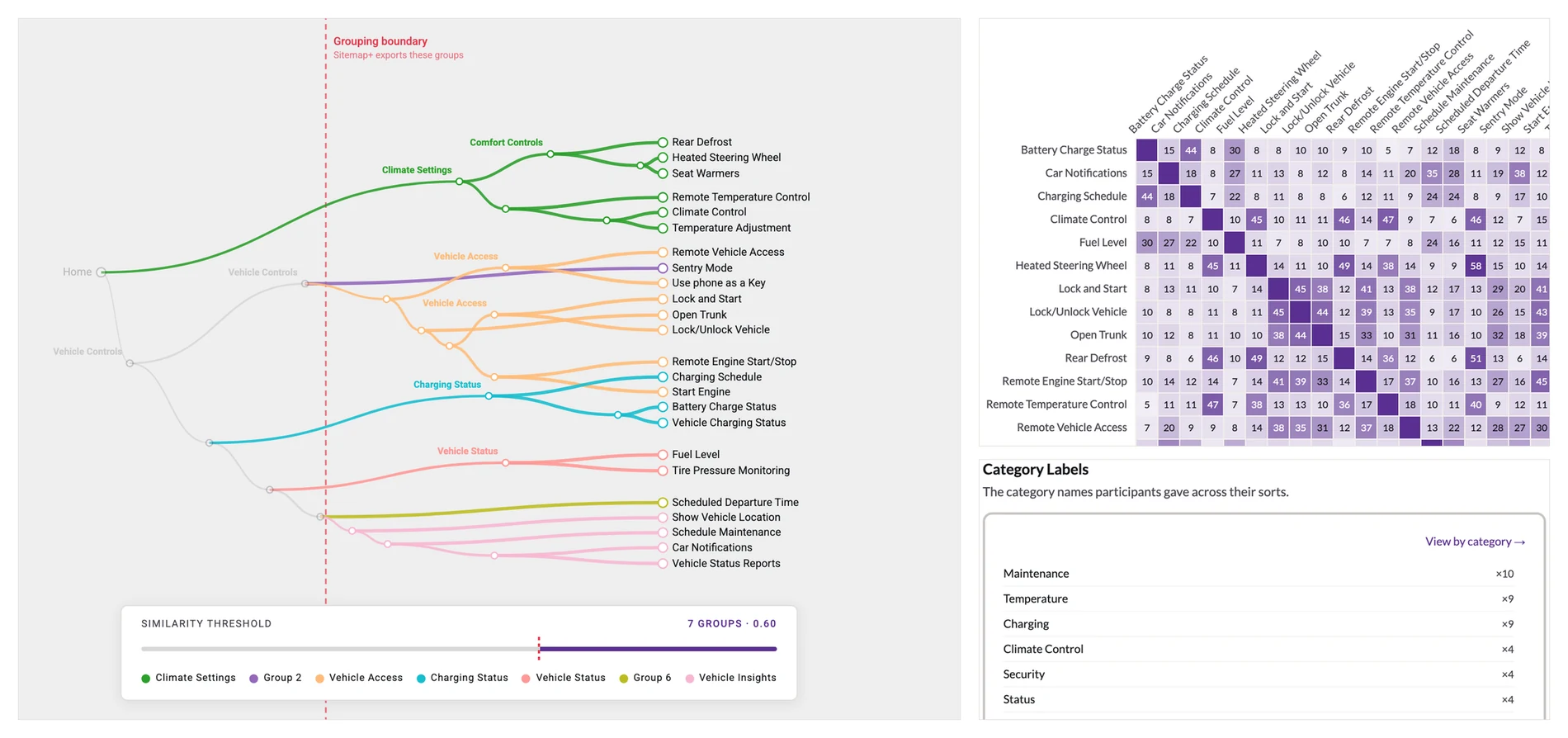
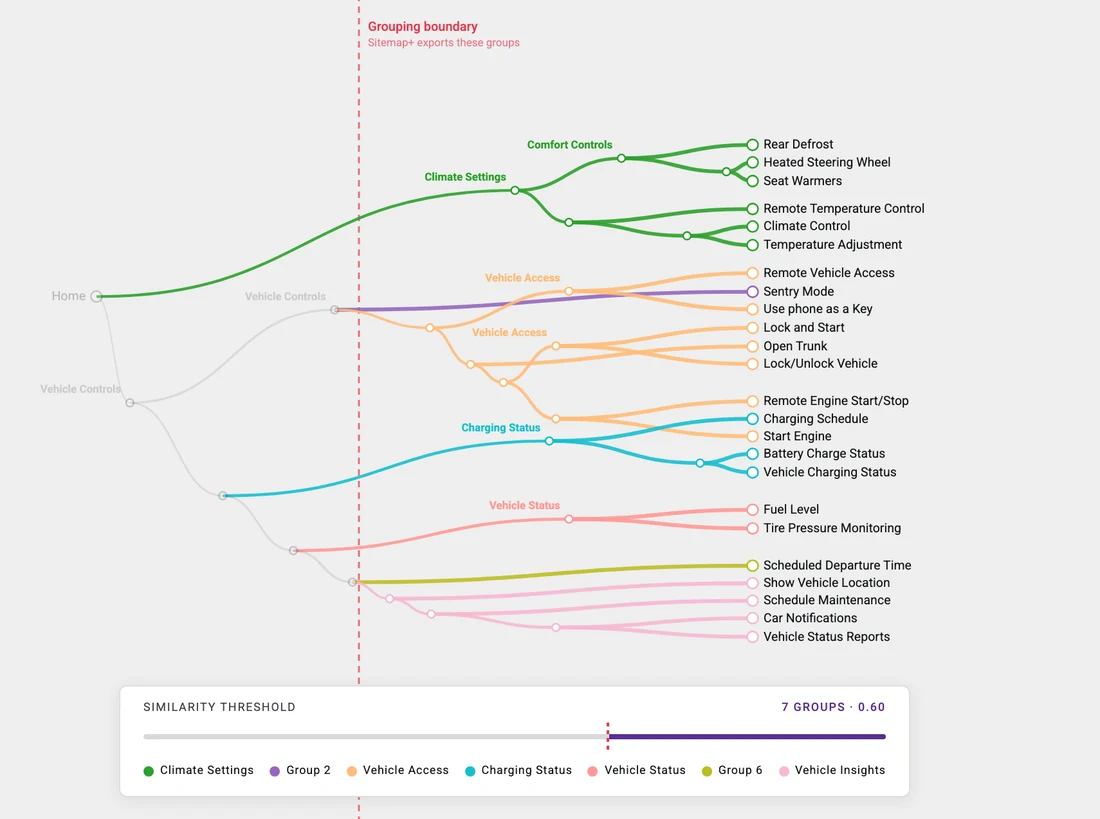
Dendrogram
See how the strongest groupings change as you move the similarity threshold.
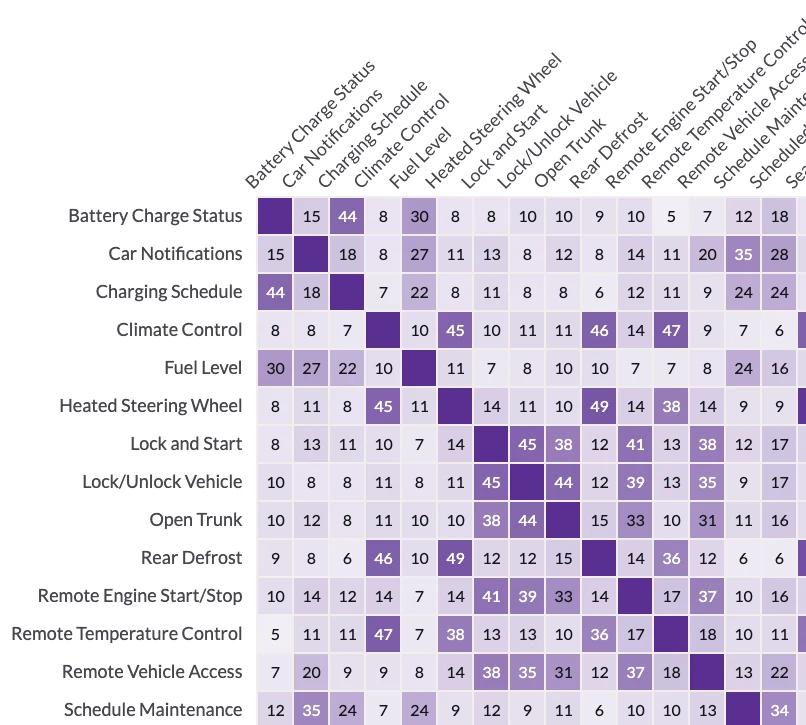
Similarity matrix
See how often each pair of items was grouped together.
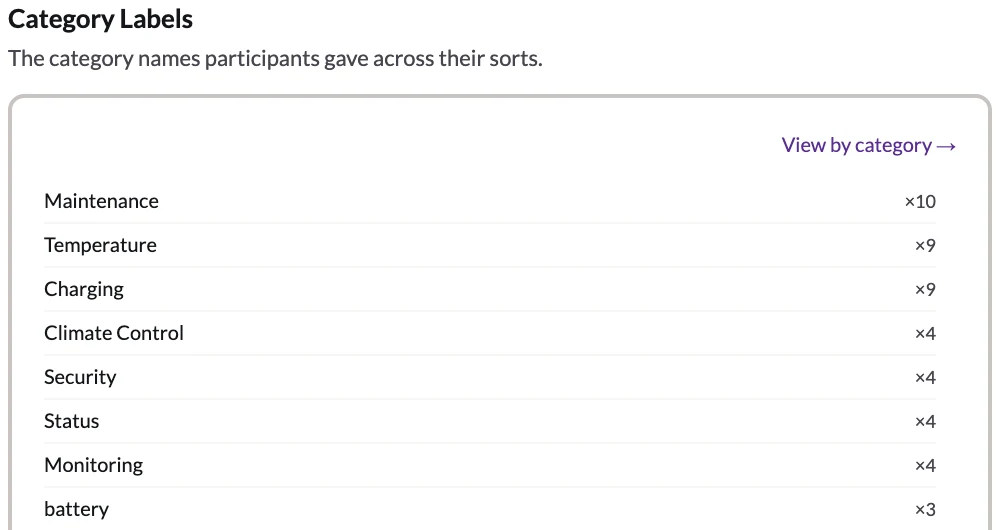
Category labels
See the names participants gave their groups.
Stable groups
Identify the clusters with the strongest agreement to find the safest backbone for your information architecture.
Ambiguous + outlier items
Spot items that split across several plausible groups, and items that don’t show a clear home.
Individual sorts + exports
Review every participant’s sort, export the full results as CSV, and export sitemap screens for sharing.
Only in UXbeam
UXbeam surfaces the mental models in your data, opens any one as an editable sitemap, and carries that structure into tree testing so you can optimize task success.
01
Discover the mental models inside your card sort
A single card sort can reveal several coherent ways participants expect the same product to be organized.
Grouped by vehicle system
Grouped by proximity to the car
UXbeam shows whether participants converge on one structure or whether several viable sitemaps hide inside the aggregate result.
02
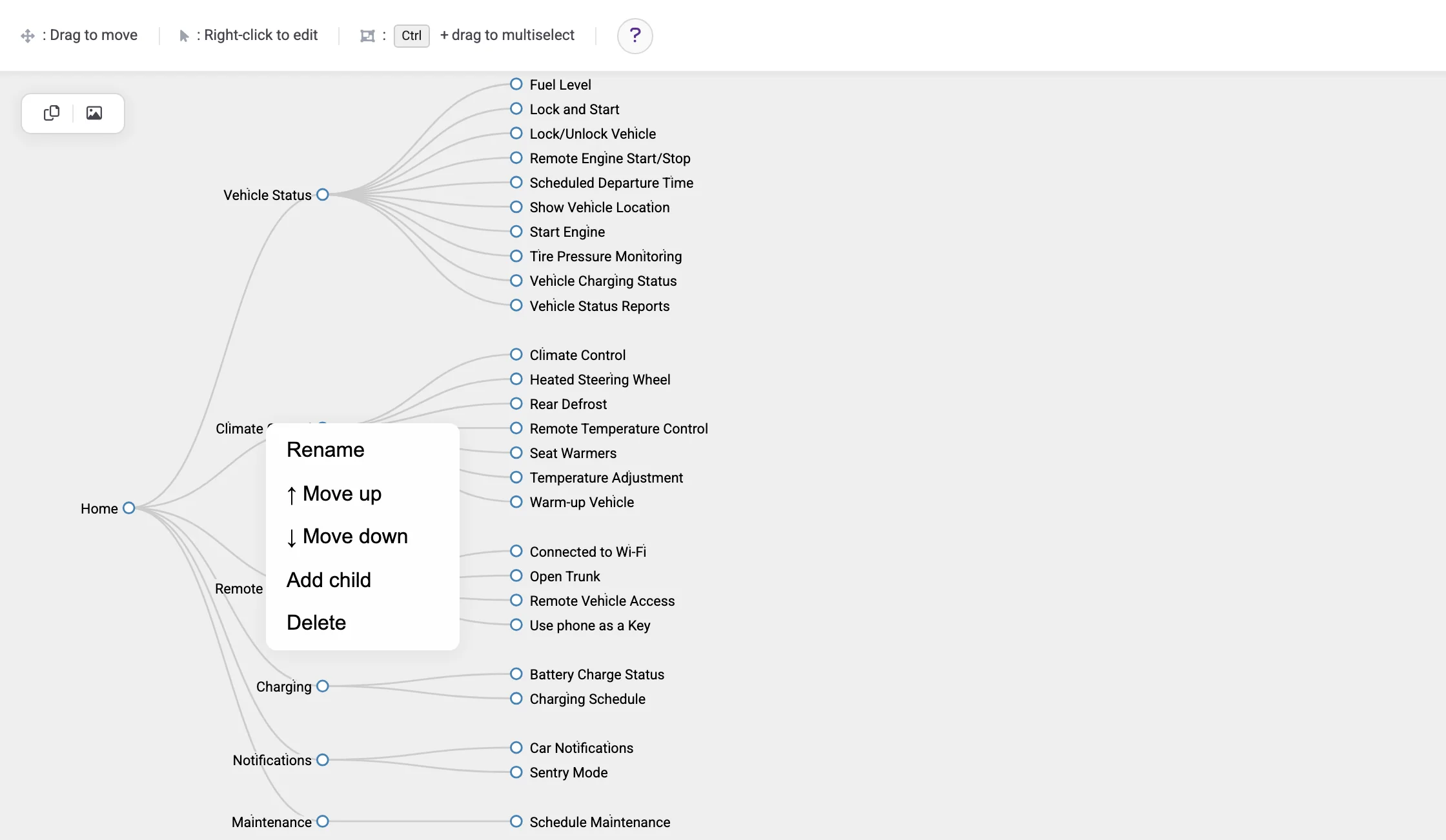
Open user groupings as editable sitemaps
Choose the groupings or mental models you want to pursue and open each as an editable sitemap in one click, without rebuilding the structure in another tool.
Sitemap this opens the grouping in a pre-populated tree editor. Rename, merge, move or delete items yourself, or let AI optimize the structure.
03
Card Sort → Sitemap → Tree Test,
built as one flow
Discover how your users organize the product, draft the sitemap, then validate the critical user journeys with a tree test.
How your users group your features and content.
A candidate structure you edit and save as a version.
Iterate until your users can find what they need.
In a UXbeam study of an automotive app, the card sort surfaced a second structure alongside the conventional one. Both were tree tested on the same tasks.
1Card sort
- 24 feature cards
- 60 participants
2Two mental models
Conventional OEM
Proximity-based
3Tree test
- 8 same tasks
- 36 participants
4Task success
Overnight security monitoring
Tree testing showed the new mental model outperformed the conventional one.
Worked examples
The complete card sorting tool, free
- Unlimited participants
- Full analysis included
- CSV + sitemap exports
Frequently asked questions
How does UXbeam compare with other free card sorting tools?
UXbeam is card sorting software for information architecture, and the complete workflow is currently free to use. There is no cap on studies or participants, every participant sort is viewable, the full analysis is included, and results export at no cost. No credit card is required.
What if participants disagree about where things belong?
Several viable architectures can hide inside one aggregate result. Averaging them can produce a structure no participant actually proposed. UXbeam surfaces the distinct mental models separately, so you read each one on its own terms and decide which to build, or take two of them into a tree test and let task success settle the question. When participants group the cards similarly, that agreement is visible in their individual sorts.
What does UXbeam analyze in a card sort?
Enough to defend a structure decision. You see which groups hold together across participants and which fall apart, how often any two items were paired, the category names your participants wrote in their own words, the items that never settled anywhere, and the distinct mental models when more than one is present. The dendrogram, similarity matrix, category labels, stable groups, ambiguous and outlier items, and every individual sort are generated from your study results in real time.
Can card-sort results become a sitemap?
Yes, and only in UXbeam does it happen without leaving the study. Pick the grouping or the mental model you want to build on, open it with Sitemap +, and the structure arrives pre-populated in an editable sitemap. Rename, merge, move and remove until it is the architecture you intend to ship, then save it as a version. Select “Tree Test this” and the sitemap opens as a tree test with the structure already in place. Nothing is retyped into a second tool, and the link between the card sort and the test stays intact.
How much work does it take to turn results into a sitemap?
As much or as little as you want. For manual control, choose the grouping or mental model, open it with Sitemap +, and shape the structure yourself. For speed, use AI-assisted sitemap optimization to propose a stronger structure in one step, then keep, adjust or ignore what it puts forward. Naming works the same way: you can inspect the category labels your participants actually supplied, including how often each one was used, and UXbeam can recommend a consolidated label when the wording is scattered.
Card sorting or tree testing: which should you use?
Use card sorting when you know what needs to be included but still need to decide how participants would organize it. Use tree testing once you have a structure and need to know whether participants can find what they need.
What can you view and export?
Everything the study produced. Every participant sort is viewable individually. Participant-by-card data downloads as CSV for your own analysis, and saved sitemap screens export as SVG for stakeholder review and design handoff. The full analysis stays live in UXbeam, so the evidence is still there when someone questions the structure six weeks later.
