What a redesign deletes
By UXbeam, information architecture tools and services since 2021 · September 8, 2026
Major redesign backlash is usually explained as "users hate change." The best-documented cases show something more specific: a product can invalidate what its users know faster than they can, or will, relearn it. That cost can be anticipated and managed.

In January 2025, the incoming interim CEO of Sonos sent employees a memo describing what the previous eight months had felt like from the customer's side. In the rendering obtained by Bloomberg, it named the failures plainly: customers' alarms not going off, kids unable to hear their playlist at breakfastBloombergBloombergSonos CEO Is Leaving After Botched App Redesign. It is a striking passage to find in an executive memo, because it is not about strategy or markets. It is about small, rehearsed, daily behaviors that a software release had interrupted.
The Sonos app redesign of May 2024 has already become shorthand for a botched launch. The shorthand obscures what actually happened, and what it shares with a series of other episodes: Snapchat in 2018, Windows 11 in 2021, WordPress at the end of 2018. The usual explanation is change aversion: users hate change and eventually get over it. Sometimes that is all it is. But the best-documented cases record a more specific loss than dislike of change.
What users know comes in three forms, and the cases sort by which one broke. There are learned procedures: the finger knows where the button is. There are mental models: the user knows how the product is organized and why. And there are valued capabilities: things the product did yesterday that someone's routine depends on. Backlash looks the same from the outside in all three. The underlying loss is different, and so is the repair.
None of this argues for freezing products. Products have to evolve, and evolution deletes things; some user pain is an unavoidable cost of change, and backlash by itself does not prove a strategy wrong. The question the record raises is narrower: how much learned behavior, capability, and structure can a migration disrupt at once before its cost overwhelms its benefit, and how much of that cost could have been anticipated.
Sonos: when capabilities disappear
On April 23, 2024, Sonos announced a "completely reimagined" app; on May 7 it replaced the old one in place. iPhone owners had no way to roll back, and Android owners could only sideload old versions. When users asked for the old S2 app to be re-released, CEO Patrick Spence said in an August Reddit AMA that months of changes to speaker and cloud software meant a re-release would make the problems worse, not betterThe VergeThe VergeSonos CEO says the old app can't be re-released. For practical purposes, the migration was mandatory. The rebuild had a stated strategic logic: Sonos described taking a monolith apart into modular parts, and told investors the rearchitecture was essential to expanding into new categories beyond the home.
The new app was faster, and early hands-on coverage said so. It also shipped without alarm management, sleep timers, local music library support, and queue and playlist editing, and its screen-reader support was broken for blind usersMosenMosen At LargeSonos has broken accessibility for its blind users. These were not layout adjustments. They were capabilities that structured people's days, and their absence was documented in Sonos's own support forums within hours.
What happened next is unusually well recorded, mostly by Sonos itself. Chief product officer Maxime Bouvat-Merlin initially told The Verge that rebuilding a core product from the ground up takes courageThe VergeThe VergeSonos responds to the new app's critics. By July 25, Spence had published a personal apology with a month-by-month restoration scheduleSonosSonos CommunityUpdate on the Sonos app from Patrick Spence. By the end of August the company was tracking fixes on a public Trello board.
On the August 7 earnings call, Sonos put numbers on the recovery: 20 to 30 million dollars of short-term investment, fourth-quarter revenue guided to 240 to 260 million dollars with the app named as a cause, and two hardware launches delayed until the app met the quality bar. Spence's own diagnosis on that call was blunt: his push for speed had backfiredQ3 FY24 callSonos Q3 FY2024 earnings callTranscript. In October the company tied executive bonuses to app quality. In January 2025 Spence stepped down. Sonos's announcement gave no reason, stated the change was unrelated to the quarter's results, and did not mention the appSonosSonos NewsroomSonos Announces CEO Transition; the timing is simply part of the record, and supplying a cause the company did not state would overreach. Interim CEO Tom Conrad, who wrote the memo about alarms and breakfast playlists, later described the failure as changing too much too fast with tactical errors in the rollout. Conrad criticized the pace and rollout, not the stated architectural goal.
SONOS, APRIL 2024 TO JANUARY 2025
- Apr 23"Completely reimagined" app announced
- May 7New app replaces the old one in place
- May 9Chief product officer: rebuilding from the ground up "takes courage"
- Jul 25CEO apology with month-by-month restoration schedule
- Aug 7Earnings call: 20 to 30 million dollar recovery cost, lower Q4 guidance, two launches delayed
- Aug 30Public Trello board tracking app fixes
- Oct 1Seven commitments; executive bonuses tied to app quality
- Jan 13CEO transition; the company's announcement states no reason
Two things complicate the simple version. First, Sonos tested. There was a beta program, and according to accessibility advocate Jonathan Mosen, who published his warning three days before launch, a blind beta tester had already flagged the screen-reader breakage. Sonos's own chief legal officer later acknowledged that the company's list of essential bugs had not been comprehensive enoughBloombergBloomberg OpinionHow Sonos Botched an App and Infuriated Its Customers. Second, the financial picture had more than one cause: Sonos had been citing soft category demand before the app ever shipped, and the quarter that contained the crisis actually grew year over year on the strength of a new product. By November, Sonos told shareholders that the recovery work had progressed enough to ship the two delayed products in time for the holidays. Sonos's own account is enough: the app problems cost money, delayed products, and consumed a year of recovery work.
Snapchat: when the sorting rule changes
The Snapchat redesign of early 2018 removed almost nothing. What it changed was structure. Friends' Stories, previously a recency-sorted list on the right side of the app, merged into an algorithmically sorted feed on the left; publishers and creators moved to Discover. The strategic logic was explicit: stop making personal friends compete with professional creators for attention in the same feed, and give publishers and creators a dedicated surface Snap could invest in and monetize. The cost was a sudden change to where friends' content appeared and how it was ordered. Snap support confirmed there was no way to revertTechCrunchTechCrunchSnapchat's big redesign bashed in 83% of user reviews.
The reaction was large and countable. In the early-rollout countries, including the UK, Australia, and Canada, 83 percent of the 1,941 App Store reviews of the update gave it one or two stars, per Sensor Tower data provided to TechCrunch. A Change.org petition against the redesign passed 1.2 million signatures, and Snap answered it directly on the platform, saying it understood the new app had felt uncomfortable for manyTechCrunchTechCrunchSnapchat responds to the Change.org petition.
Snap itself documented the disruption. Spiegel had told investors in November 2017 that the redesign would likely be disruptive to the business in the short term, a risk the company said it accepted for long-term benefitsSnap Q3 2017Snap Inc. Q3 2017 earnings callTranscript. Q1 2018 arrived and Snap told investors the redesign had created revenue headwinds by disrupting user behavior, and that March usage ran below the quarter's averageSnap Q1 2018Snap Inc. Q1 2018 earnings callTranscript. The next quarter brought the first quarter-over-quarter decline in daily active users Snap had ever reported, from 191 to 188 million, which Spiegel attributed to redesign disruption while also naming a confound: Android performance regressions were hurting a large share of users at the same time. The same calls recorded what the redesign was buying: time spent held above 30 minutes a day, new-user retention among people over 35 rose more than 8 percent, and daily viewers of Publisher Stories and Shows on iOS grew more than 15 percent that yearSnap Q2 2018Snap Inc. Q2 2018 earnings callTranscript.
In May, Snap restored recency sorting in communication and moved friends' Stories back to the right side. The documented disruption came from the migration path: two behaviors users had kept separate for years, checking messages and browsing Stories, were merged into one algorithmically sorted surface in a single step. Snap kept the strategic separation of friends from creators while reversing parts of the interaction model. The business goal survived, but the way users were moved into it changed.
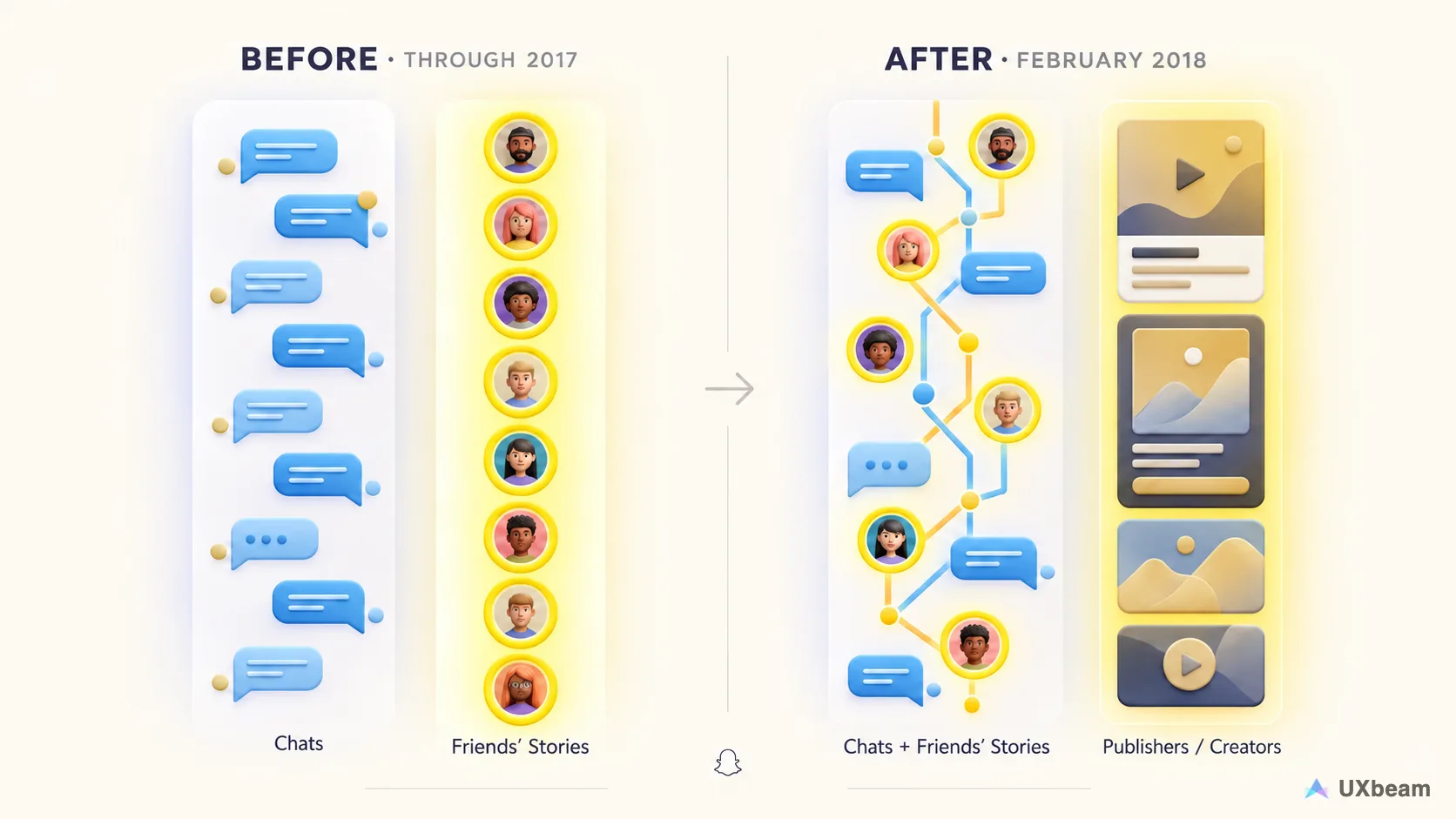
May 2018 revision: Snap restored recency sorting for communication and moved friends' Stories back to the right. Friends and creators remained in separate areas.
Windows 11: the changelog as evidence
Windows 11 removed several long-standing taskbar and desktop behaviors: the taskbar could no longer be docked to the top or sides of the screen, files could no longer be dragged onto taskbar icons, taskbar buttons could no longer be ungrouped, the clock lost its seconds option, and the right-click menu moved familiar commands behind an extra click. Ars Technica's contemporaneous review carried the summary line: an attractive new design overshadowed by regressions and high system requirements. The refresh itself was widely liked; the criticism aimed at the removals, not the new lookArs TechnicaArs TechnicaWindows 11: The Ars Technica review.
Nobody was forced to upgrade; Windows 10 remained supported until October 2025, and adoption data shows many stayed on Windows 10. The strongest evidence in this case is not complaint volume. It is Microsoft's own release channels. Taskbar drag-and-drop returned with the 2022 update. The seconds display returned in the mid-2023 update wave. The option to never combine taskbar buttons returned in late 2023, introduced on Microsoft's Insider blog as an early version of one of the most requested features for Windows 11Windows Insider BlogWindows Insider BlogAnnouncing Windows 11 Insider Preview Build 23466. Taken together, Microsoft's release notes show which removed behaviors it later restored after launch. Windows 11 had a months-long public preview before launch. What the changelog records is the gap between what survived preview testing and what the installed base later pushed to restore.
REMOVED AT LAUNCH, LATER RESTORED
| Learned behavior | Removed | Restored |
|---|---|---|
| Dragging files onto taskbar icons | October 2021 | Windows 11 2022 Update, September 2022 |
| Seconds in the system-tray clock | October 2021 | Mid-2023 update |
| Never combining taskbar buttons | October 2021 | Late-2023 update · "one of our most requested features" |
| Docking the taskbar to other screen edges | October 2021 | Not restored |
One caution. Windows 11's slow adoption cannot be read as a referendum on its design. Strict hardware requirements excluded many machines outright, and Windows 11 only took the lead in Statcounter's worldwide desktop data in mid-2025, as the Windows 10 support cutoff approachedStatcounterStatcounter GlobalStatsWindows version market share, desktop, worldwide. Those confounds affect the adoption numbers, not the restoration record.
WordPress: migration with an escape hatch
WordPress 5.0 made the block-based Gutenberg editor the default in December 2018, replacing an editing model that a large fraction of the web had used for fifteen years. Unlike the other cases, the project shipped an official way out: the Classic Editor plugin, with support promised in the release post itself through 2021WordPress.orgWordPress.org NewsWordPress 5.0 "Bebo". That commitment was extended through 2022, and the plugin page today still carries the promise of support until 2024 "or as long as is necessary." The plugin currently reports more than eight million active installsClassic EditorWordPress.orgClassic Editor plugin.
The feedback record is unusually public. The Gutenberg feedback plugin sits at 2.1 out of 5, with one-star reviews outnumbering five-star reviews roughly three to oneGutenbergWordPress.orgGutenberg plugin. Before launch, the accessibility team lead resigned, writing that the situation had become too politically complicated and that the team lacked the React expertise the new codebase demandedRietveldrianrietveld.comI have resigned as the WordPress accessibility team lead. Afterward, a crowdfunded independent audit, which Automattic helped pay for, logged failures against 30 WCAG 2.1 success criteria and described the user experience as consistently poor, while praising the markup Gutenberg produced as clean and semantically correctWPCampusWPCampus / Tenon LLCGutenberg accessibility audit results.
Matt Mullenweg defended the strategic direction, arguing the block model could do several times more than the classic editor and kept WordPress competitive with commercial site builders. He noted that more than a million sites had opted in or out before release, and conceded process failures on accessibilityWP TavernWP TavernMullenweg addresses Gutenberg controversies at WordCamp Portland.
Gutenberg had been publicly testable for more than a year before launch, yet substantial backlash followed. What the escape hatch bought was a metered migration instead of a forced one, and with it, measurement: the Classic Editor's install base shows that many sites continue to rely on the old editing model, whether by preference, compatibility, or workflow necessity. The support timeline has been extended repeatedly. The block-editor strategy itself was never reversed.
The counterexamples
Two smaller episodes show why backlash alone is not enough to judge a redesign. In 2022, Instagram tested a full-screen, recommendation-heavy feed. A petition gathered more than 170,000 signatures within a week, and two of the platform's most-followed users amplified it. But the head of Instagram's stated reason for pulling the test was not the petition. He told the newsletter Platformer that people were frustrated and the usage data was not goodPlatformerPlatformerInstagram walks back its changes. Because the change was a test, walking it back took about two weeks, not a year.
Slack's 2023 redesign restructured the sidebar its users navigate all day, moving DMs and activity into separate views; university IT pages told staff the update would arrive automatically and could not be revertedStanford UITStanford University ITSlack Redesign Arrived Dec. 19. The criticism was loud, and it is the purest information-architecture example in this set. Yet the documented consequence is essentially nil: no ratings collapse, no usage disclosure, nothing attributed in the parent company's investor materials. Slack's design lead defended the density trade-off, and the company later restored the always-visible workspace switcher as an optionSlackSlack Help CenterSwitch between workspaces. The public record supports a narrower conclusion here: one navigation change was reversed, and no broader business harm is documented.
What these cases do not prove
None of this shows that the companies skipped research. Sonos ran a beta. Snap told investors in advance that disruption was likely. Windows 11 and Gutenberg both had long public previews. Nor do the business outcomes trace cleanly to design decisions: demand cycles, hardware requirements, platform bugs, and competition ran through every one of these stories, and the companies named several of those confounds themselves. Nor does backlash prove a strategic direction wrong: Snap kept the friends-and-creators separation through its walk-back, the block editor stayed and matured, and Sonos's new architecture shipped the products it was built for. Across the cases, users lost different things: capabilities, familiar procedures, or structural expectations. The effects appeared quickly, while some recoveries took months or years.
Testing the structure before the migration
These cases suggest a practical pre-migration discipline. The window for it closes earlier than launch day: a migration becomes hard to change once engineering investment, launch dates, marketing, and executive commitments accumulate around it, often well before users are required to move. None of this is an argument against change. Each step is a way to estimate the likely migration cost before rollout.
BEFORE A MIGRATION BECOMES HARD TO REVERSE
- List what changes or disappears. A capability parity audit, similar to feature parity but broader:
- capabilities the current product has that the new one will not have at launch
- learned procedures and workflows: shortcuts, defaults, muscle memory
- structural assumptions: where things live, how they are sorted and grouped
- task effort and error risk: added steps, added time, new kinds of mistakes, new memory burden
- accessibility, and performance or reliability where the rebuild touches them
- expectations users hold about how the product behaves
- Identify the high-cost relearning.
- which frequent tasks depend on the old behaviors, and how central they are to a daily routine
- which users are most exposed and least able to adapt; at Sonos that included screen-reader users, whose access broke entirely
- Test the proposed structure early.
- where the risk is navigation or organization, run the new structure against current users' tasks before the product is built around it; structural methods such as tree testing answer exactly this question
- and only this question: structural testing will not surface capability loss, performance problems, or reliability bugs
- betas still matter, but they arrive late and bundle structure with visuals, architecture, and bugs, when the ship decision already has momentum
- Stage the migration.
- preserve a rollback or escape hatch where practical: Instagram could retreat in two weeks because the change was a test with an exit, and the Classic Editor metered WordPress's migration for years
- define in advance what evidence lets the change roll out broadly, and what sends it back
The Sonos episode shows why the first step matters. At least some launch gaps were known: the screen-reader breakage had been flagged by a beta tester, according to the advocate who published the warning before release, and the company's own chief legal officer later acknowledged that the essential-bug list had not been comprehensive enough. A parity list does its work when each entry has a visible owner and forces a decision before launch, rather than competing for attention inside a release triage queue.
The lesson from Sonos's costly 2024 app release is not that products should preserve everything users know. A structural migration is a bet that the value of the new model will outweigh the cost of what users have to relearn or give up. Teams can make that bet with better evidence by documenting what changes, testing the riskiest structural assumptions early, and staging rollout so the plan can still change.
That is one reason structural testing matters: teams can test whether people can still find their way through a proposed structure before it reaches the full user base.
Sources
- Sonos, “Sonos Unveils Completely Reimagined Sonos App,” press release, April 23, 2024.
- Patrick Spence, “Update on the Sonos app,” CEO open letter with restoration schedule, July 25, 2024.
- Sonos Q3 FY2024 earnings call, transcript, August 7, 2024.
Recovery cost of 20 to 30 million dollars, Q4 revenue guidance of 240 to 260 million dollars, two delayed product launches, and “my push for speed backfired.” - Sonos, “Sonos Announces CEO Transition,” January 13, 2025, and the accompanying SEC Form 8-K.
Neither states a reason; the release says the change is unrelated to the quarter's results. - Jonathan Mosen, “Sonos has broken accessibility for its blind users,” May 4, 2024.
- Jay Peters, “Sonos CEO says the old app can't be re-released,” The Verge, August 20, 2024.
- Chris Welch, “Sonos responds to the new app's critics,” The Verge, May 9, 2024.
- Mark Gurman, “Sonos CEO Is Leaving After Botched App Redesign,” Bloomberg, January 13, 2025.
Carries the Conrad memo passages quoted above. - Dave Lee, “How Sonos Botched an App and Infuriated Its Customers,” Bloomberg Opinion, September 23, 2024.
Cited here only for the on-record acknowledgment by Sonos chief legal officer Eddie Lazarus. - Snap Inc. earnings call transcripts: Q3 2017, Q1 2018, Q2 2018.
Advance disruption warning; revenue headwinds attribution; the 191 to 188 million DAU decline and its stated causes. - Josh Constine, “Snapchat's big redesign bashed in 83% of user reviews,” TechCrunch, January 11, 2018.
Sensor Tower data: 83 percent of 1,941 update reviews at one or two stars in early-rollout countries. - TechCrunch, “Snapchat responds to the Change.org petition,” February 21, 2018.
- Andrew Cunningham, “Windows 11: The Ars Technica review,” October 2021.
- Microsoft Windows Insider Blog, “Announcing Windows 11 Insider Preview Build 23466,” May 24, 2023, with the Windows 11 2022 Update release post and KB5027303.
The restoration record: drag-and-drop, clock seconds, never-combined taskbar buttons. - Microsoft, “Windows 10 end of support”; Statcounter, Windows version market share.
- Matt Mullenweg, “WordPress 5.0 ‘Bebo’,” WordPress.org, December 6, 2018; the Classic Editor and Gutenberg plugin pages (figures retrieved September 8, 2026).
- WPCampus, “Gutenberg accessibility audit results,” with the Tenon LLC executive summary, May 2019.
- Rian Rietveld, “I have resigned as the WordPress accessibility team lead,” October 2018; WP Tavern, “Mullenweg addresses Gutenberg controversies,” November 2018.
- Casey Newton, “Instagram walks back its changes,” Platformer, July 28, 2022.
- Slack, “A redesigned Slack, built for focus,” August 9, 2023; Slack Help Center, “Switch between workspaces”; Stanford UIT, “Slack Redesign Arrived Dec. 19.”