Card sorting case study
Card sorting government services: topic or task?
By UXbeam, information architecture tools and services since 2021 · Updated September 27, 2026
Government digital teams have spent years reorganizing services around user needs instead of internal government structures. This study asks a direct question: can card sorting investigate the organizing principle itself, rather than only how participants group the cards?
In a 20-card open sort around major life transitions, one topic-based mental model dominated. When the study had 69 responses, UXbeam also detected a smaller action-based mental model. The two mental models did not just place cards differently; they reflected different classification rules.
At 69 responses, UXbeam found two mental models
Model A · 57 participants
The 57-person mental model organized services largely by topic or domain, with participant category names such as Housing, Education, Employment, Childcare, Care, and Financial support.
Model B · 9 participants
The 9-person mental model organized the same services much more strongly around actions, with category names such as Find, Apply, comparing and understanding options, and challenge decisions.
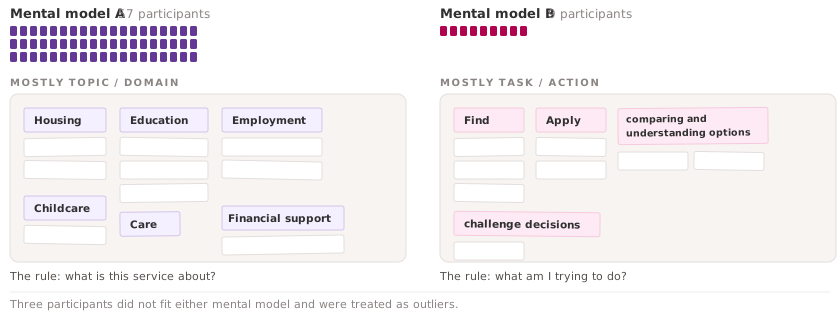
The topic model asks what is this service about?; the action model asks what am I trying to do?
Averaged into one hierarchy, these two patterns can describe a compromise IA that neither group actually proposed.
What the two mental models were organizing around
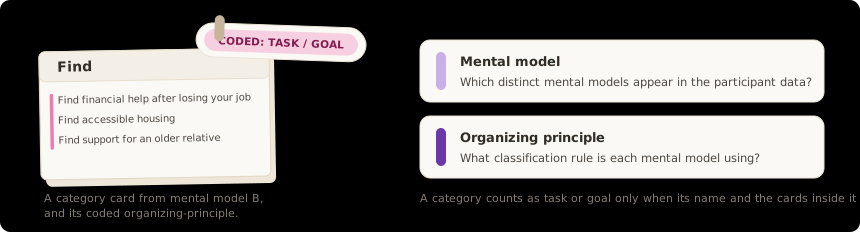
A mental model represents a subset of participants who organized the cards in a similar way. UXbeam detects those mental models from similarities in how the cards were placed. The organizing principle is a separate analysis: we identified it from each participant-created category name and the cards inside it.
Education was coded as topic/domain. Find was coded as task/goal only when the cards inside it were also united by finding something.
The two analyses answer different questions:
| Analysis | Question |
|---|---|
| Mental models | Which distinct mental models appear in the participant data? |
| Organizing principles | What classification rule is each mental model using? |
At 69 responses, the two analyses aligned perfectly. Among the 61 participants with a codeable dominant principle, all 8 members of the smaller mental model were task/goal-dominant, while none of the 53 members of the dominant mental model were. The association was statistically significant (Fisher's exact test, p < 0.001).
Both analyses use the same card-sort sessions: Mental Model Detection uses placements, while organizing-principle coding uses category names and their contents. The result therefore measures agreement between two analyses of the same behavior, not evidence from an independent dataset.
This is the 69-response result.
Topic, task and audience are established IA organizing schemes
The distinction between organizing by topic, task or audience is not new. In Information Architecture for the World Wide Web, Louis Rosenfeld and Peter Morville described organization schemes such as topic, task, audience and metaphor, alongside hybrids that combine more than one schemeRosenfeld & MorvilleO'Reilly MediaInformation Architecture for the World Wide Web.
The organizing principle determines the rule people use to decide what belongs together; an audience scheme, for instance, asks who the content is for. The same services can support several plausible schemes, and each can produce a materially different structure.
Card sorting usually answers where the items belong
An open card sort usually starts with a content or feature inventory: participants group the cards and name the categories, and the researcher works from those placements toward an information architecture.
But the cards themselves can already point toward one kind of grouping. Billing reads like a topic or object; Pay an overdue invoice reads like a task; When you move home reads like a life event.
Card-sorting guidance warns about this directly. Nielsen Norman Group recommends neutral wording because terminology can influence how participants group cardsNN/gNielsen Norman GroupCard Sorting: Pushing Users Beyond Terminology Matches. If several labels repeat the same words or grammatical pattern, participants can match the terminology rather than the underlying concepts.
Our question came before the sitemap: whether participants would organize the same services primarily by topic, task, audience, life event, object, or another principle. That required a card set in which several plausible schemes had recurring evidence.
From recurring IA question to a repeatable method
We had run into this question in earlier IA work, where the useful decision was sometimes the organizing principle rather than the final hierarchy. That pushed us to formalize a repeatable way to study the choice directly. This government-services study is a deliberately constructed example of that approach.
Designing a sort where several principles can compete
We created 20 cards covering government services around work, education, housing, care, disability, retirement and other life transitions. Examples included:
- Find financial help after losing your job
- Apply for funding to retrain for a new career
- Get childcare support while attending training
- Find accessible housing after developing a disability
- Compare education options after compulsory schooling
- Report a death and find out what must be done next
The cards were deliberately selected so several plausible classification cues recurred across the set. Participants could therefore privilege topic, task, life event, or another organizing principle in an otherwise normal open card sort:
| Organizing principle | Examples available in the set |
|---|---|
| Topic / domain | housing, education, work, care |
| Task / goal | find, apply, compare, understand, challenge |
| Audience | parents, carers, older people |
| Life event / context | moving, losing a job, retiring |
| Object / entity | benefits, courses, qualifications |
To participants, it was a normal open card sort. The difference was how the 20 cards were selected and how the results were analyzed.
We were not trying to make every card neutral or deliberately ambiguous. We designed the set so several plausible classification schemes had enough recurring evidence to compete.
Government IA has already changed its organizing principle
First-generation government websites often mirrored government itself. Departments owned services, so departments became the navigation. That made sense from inside the organization, but it was much harder for citizens who did not know which department owned the thing they needed.
In the UK, this became a central problem in government digital reform. Martha Lane Fox's 2010 review of Directgov argued that people should not have to navigate the departmental structure of government before finding the service or content they need, and recommended a single government domainLane FoxCabinet OfficeDirectgov 2010 and Beyond: Revolution Not Evolution.
The following year, the team building the GOV.UK alpha put user needs onto cards. Literally: they wrote the top 100 needs onto physical cards, prioritized them, and sorted them into categories on the wall. GDS's 2011 project history still preserves the photographGDSGovernment Digital ServiceA GDS Story 2011.
Three boards, one shift in the unit of organization. The middle frame carries the 2011 GDS photograph of user needs cards in publication (credit Richard Pope; the GDS page publishes under the Open Government Licence v3.0 except where otherwise stated).
By October 2012, GOV.UK had launched. GDS described the new website as planned, written, organized and designed around what users needed to get done, rather than around the way government wanted people to do itGDSGovernment Digital ServiceGOV.UK: The start of a new way of delivering public services. The organizing principle had shifted away from internal government structure and toward user needs and tasks.
Victoria describes its public content as organized using a life-events approach, with its information architecture informed by how people experience information and services rather than by departmentvic.gov.auVictorian GovernmentUse a life events approach for digital content.
Twenty of 28 countries surveyed by the OECD in 2025 had adopted some form of life-event approach, and 13 had begun integrating some services for at least one life eventOECDOECDGovernment at a Glance 2025.
Department, task, life event: these are not alternative labels for the same hierarchy. They can change which services are considered part of the same journey, who has to coordinate with whom, and what the digital service itself becomes. They are different answers to a more basic IA question:
What should these services be organized around?
When the organizing principle is the million-dollar question
Sometimes the sitemap is the deliverable. Sometimes the more consequential decision comes earlier: what should people experience as one service, and what should organize it?
The government examples above show why. A life event can cross agencies, turning an organizing decision into a decision about service boundaries, handoffs, and which systems must coordinate.
That is a much larger design question than deciding whether Benefits belongs above or below Employment. A public-service team may be deciding whether services currently owned by different departments should become one journey, where the handoffs should disappear, and which teams or systems need to coordinate behind the scenes.
The same decision appears in products. Imagine a work-management platform. Organizing it around objects might make Projects, Tasks, People and Reports the primary model. Organizing it around goals might foreground Plan, Review, Analyze and Configure. Organizing it around workflow stages might make Setup, Execute, Monitor and Review the backbone. Those are different product models, not cosmetic rearrangements of the same menu.
A multi-audience product can raise another high-stakes version of the question. If managers and contributors disagree about one or two placements, the team may need better labels or cross-links. If they consistently use different organizing principles, the implication can be much larger: different entry points, different navigation models, or different product structures for different audiences.
The principle can shape the service itself, or become a testable structure. Often both.
A useful result at this stage: most participants understand this domain as a set of topics, while a smaller mental model understands it as a set of actions. That finding can change service boundaries, product models, entry points and research priorities before a sitemap exists.
The Mental Model Detection result changed as responses accumulated
At 69 responses, UXbeam reported a 57-participant topic-oriented mental model and a 9-participant action-oriented mental model.
In the current production result, which contains 82 response rows, the action-oriented mental model is no longer reported separately, and the UI reports One mental model dominates.
Two results from the same study.
The 69-response result is the relevant state for comparing the two detected mental models, because that is when UXbeam reported both.
Each mental model can become a candidate sitemap
At 69 responses, the two reported mental models gave two explicit IA hypotheses: one organized by topic or domain, the other by task or action. UXbeam can open either mental model as an editable sitemap and send it to Tree Testing. The alternatives remain separate rather than being averaged into one hierarchy.
What mental models and organizing principles add to card sorting analysis
Mental Model Detection separates mental models that would otherwise be blended in one aggregate dendrogram. Organizing-principle analysis identifies whether each mental model is organized by topic, task, audience, life event, object, or another classification scheme.
Method note
- Open card sort · 20 cards
- Participants: U.S.-based adults
- Mental Model Detection: 69-response result; at 82 responses the smaller mental model was no longer reported separately
- Organizing-principle coding: participant category names + the cards inside each category
See all 20 cards
- Find financial help after losing your job
- Apply for funding to retrain for a new career
- Compare courses that fit around full-time work
- Check whether a qualification is recognized by employers
- Get childcare support while attending training
- Understand how benefits may change when starting work
- Appeal a decision about training support
- Find local support for starting a small business
- Find accessible housing after developing a disability
- Apply for help adapting a home for mobility needs
- Understand tenancy rights before moving into a rented home
- Compare childcare options before returning to work
- Find support for caring for an older relative
- Arrange an assessment of a relative's care needs
- Challenge a decision about disability support
- Register with local health services after moving
- Find school support for a child with additional needs
- Compare education options after compulsory schooling
- Understand pension options before stopping work
- Report a death and find out what must be done next
Sources
- Louis Rosenfeld & Peter Morville, Information Architecture for the World Wide Web, O'Reilly Media.
Organization schemes include topic, task, audience, metaphor and hybrids. - Martha Lane Fox, Directgov 2010 and Beyond: Revolution Not Evolution, Cabinet Office, 2010.
The review argued that people should not need to navigate government's departmental structure to find services or content. - Government Digital Service, “A GDS Story 2011.”
Documents the GOV.UK alpha team's top 100 user needs being written on cards and sorted into categories on the wall. Photograph credited to Richard Pope. The page is published under the Open Government Licence v3.0 except where otherwise stated. - Government Digital Service, “GOV.UK: The start of a new way of delivering public services,” 16 October 2012.
- Victorian Government, “Use a life events approach for digital content.”
Explains how vic.gov.au uses life events to organize public content and how the approach can expose gaps or opportunities to join services. - OECD, Government at a Glance 2025, “Seamless and accessible public administrative services.”
Reports life-event adoption in 20 of 28 surveyed countries, with 13 beginning to integrate services for at least one life event. - Nielsen Norman Group, “Card Sorting: Pushing Users Beyond Terminology Matches.”
2024 update of Jakob Nielsen's 2009 guidance. Card-label phrasing can influence grouping; neutral labels reduce keyword matching.
Study data: UXbeam card sorting sessions shown on this page.