Google designed AI Overviews to do more of the searching for us. Two years on, research details where attention goes, who loses visits, and the unsettled question of whether the experience is better.
In May 2024, Google introduced AI Overviews with an appealing promise: rather than piecing together information across several searches, people could get a useful answer directly on the results page. Google said its early tests increased search use and satisfaction. It also promised links for anyone who wanted to explore further. Google, May 2024.
That was a consequential product decision. Google was giving the answer a larger role in an interface that publishers rely on to send readers to their websites. Now we have evidence from browsing records, eye tracking, controlled experiments and a large-scale source audit. Together, they reveal a more complicated outcome: the generated answer commands attention and reduces visits to source websites, while the user benefit remains harder to establish.

Google's product bet: let Search do more of the work
The proposition was strongest for complex questions. A searcher comparing several options, planning a task or learning something unfamiliar could get a synthesized starting point without opening a sequence of pages. In Google's framing, the answer and links to further reading were meant to work together.
That changes the job of the search-results page. Links still matter, but the page itself can now satisfy a substantial part of the information need. A person asking for a quick explanation may have every reason to stop there. Someone comparing medical guidance, tracing a disputed claim or choosing a service may need to see the original sources.
From Google's perspective, reducing effort may make Search more useful and encourage more queries. It may also keep more of the information-seeking experience inside Google's own interface. The second possibility is a product and business inference, not a stated objective in Google's launch announcement.
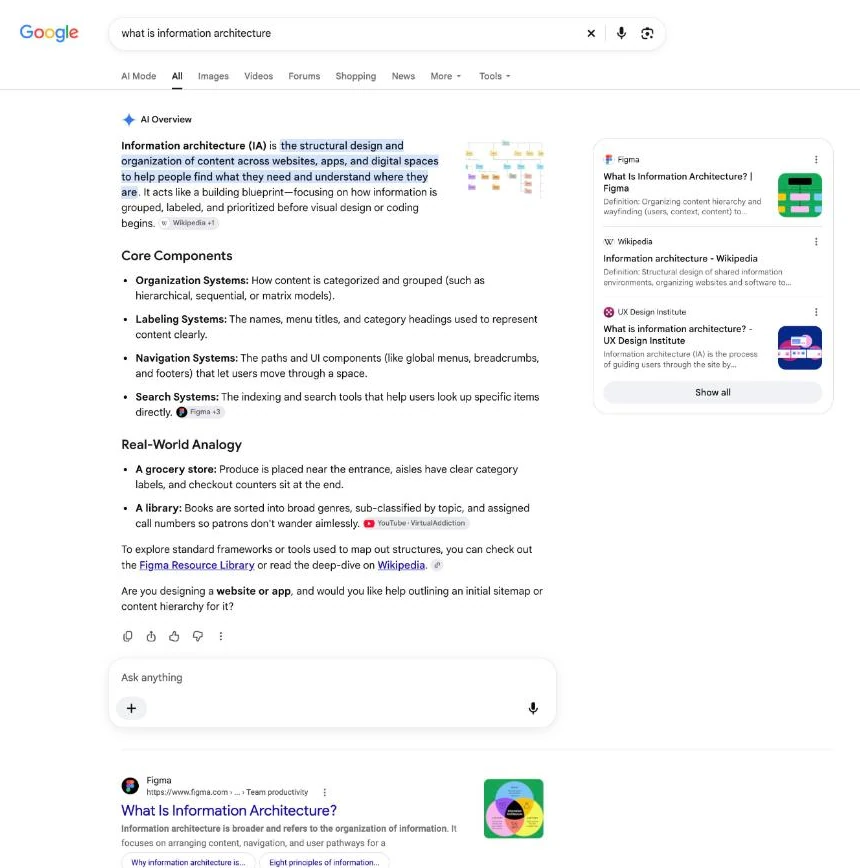
The answer occupies Search's most-attended area
An eye-tracking experiment presented at SIGIR 2026 examined how 36 analyzed participants looked at simulated Google results pages containing AI Overviews. On those pages, participants spent an average 27.3 seconds fixating on AI Overview content, compared with 14.8 seconds on traditional results on the same page.
The familiar upper-left concentration of attention remained. Putting a large synthesized answer in that area meant much of the early reading time went to the answer, while the results below continued to receive attention.
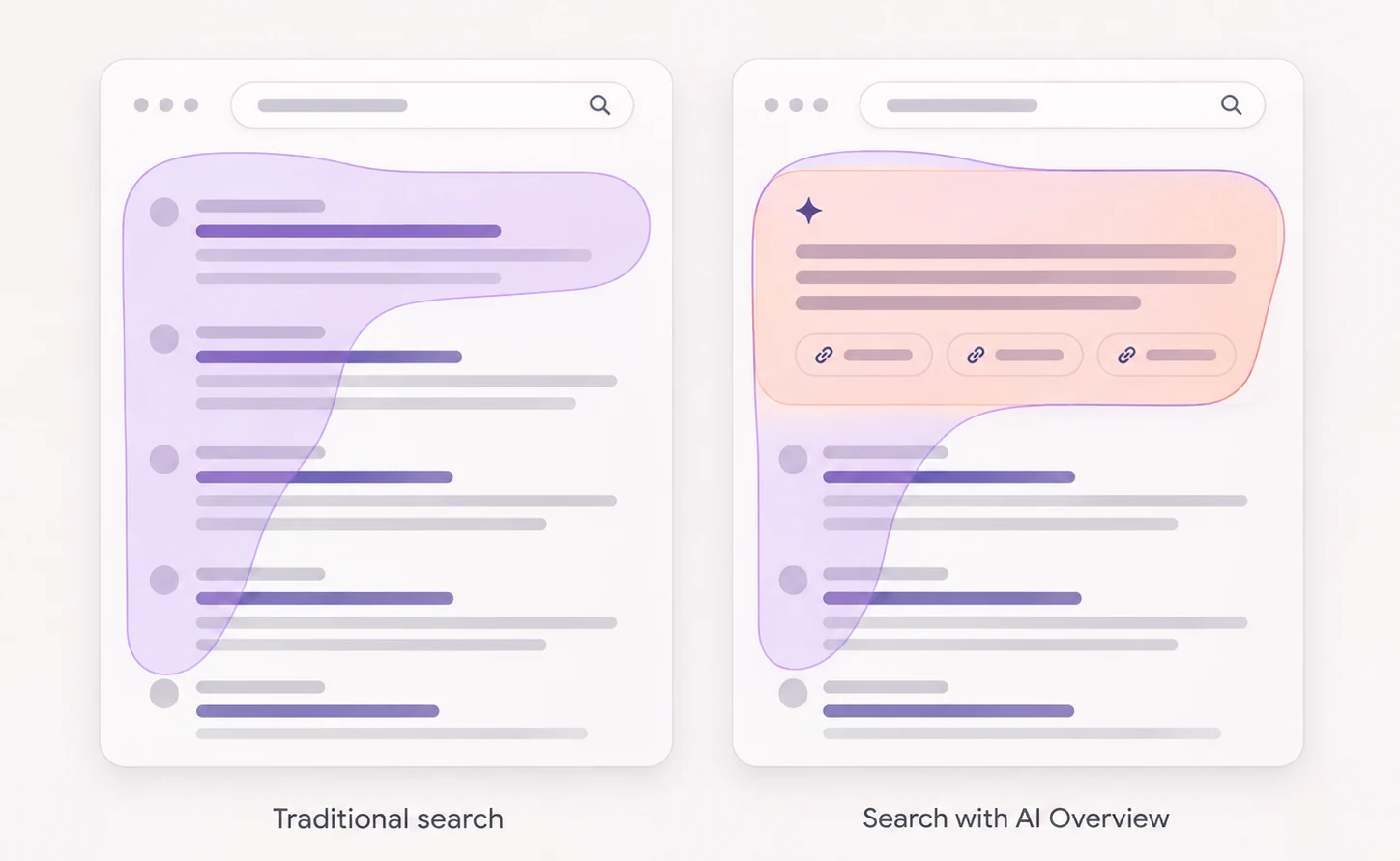
The experiment's simulated summaries did not include their source links, so it cannot tell us how often participants would have followed those links. Other studies address what people actually clicked.
Fewer visitors reach the sources
Pew Research Center analyzed browsing behavior from 900 U.S. adults in March 2025. People clicked a traditional result on 8% of visits to results pages with an AI summary, versus 15% without one. A link inside the summary was clicked on 1% of visits to pages displaying a summary. Browsing sessions also ended more often after pages with summaries.
Those observations alone could not distinguish the effect of the interface from the types of queries that triggered summaries. A 2026 randomized field experiment by Saharsh Agarwal and Ananya Sen addressed that question directly. When AI Overviews were displayed, outbound organic clicks were 39.8% lower than in the condition where they were hidden, for searches that would otherwise have shown an Overview. Sponsored clicks and overall search frequency did not change measurably in that experiment.
A separate preregistered experiment by Stephanie Wang and colleagues, with 1,100 active participants, found more publisher referrals when AI features were successfully hidden. Its AI Mode-only condition reduced referrals further. AI Mode is a different, conversational interface and should not be treated as interchangeable with an Overview on the ordinary results page.
The effect on publishers is concrete. A search can end with the reader consuming information produced by websites without visiting them. For publishers that rely on referrals to fund reporting, documentation, services or original research, that is a change in the economics of being discoverable.
Did the easier answer deliver a better experience?
Agarwal and Sen found no measurable improvement in participants' perceived search quality or ease of finding information when AI Overviews were present. Wang and colleagues found that hiding AI features did not detectably change trust or satisfaction, while their AI Mode condition reduced both.
This does not mean an Overview never solves a question. A concise answer to a straightforward lookup can be genuinely useful. In Nielsen Norman Group's exploratory research with nine participants, people combined AI answers and conventional browsing as tasks developed: one person used an Overview to check a football-goal dimension, then browsed sites for product comparisons.
The product problem is how to distinguish those situations. A quick definition and a consequential comparison can both end with no click. One may be finished; the other may merely feel finished. The experimental studies measured perceptions and behavior, but did not establish that every information need was completed correctly.
When Google supplies the answer, it also chooses the evidence
There is another consequence of putting a synthesis ahead of the sources. The generated answer chooses which facts and perspectives a person encounters before they have seen the alternatives.
In a 2026 study presented at the ACM Internet Measurement Conference, Haofei Xu, Umar Iqbal and Jacob M. Montgomery analyzed 55,393 queries and 98,020 claims extracted from AI Overviews. The study's automated assessment classified about 11% of claims as lacking support in their cited pages, including omissions, contradictions and ambiguous support. That is a measure of citation fidelity: it does not mean every such claim was factually false.
The same researchers found that nearly 30% of the domains cited in AI Overviews were absent from the conventional first-page results displayed alongside them. The cited domains were, on average, assessed as more credible than the conventional first-page domains. The synthesis may therefore bring some sources into view that traditional rankings would not have shown. Whether it accurately represents what those sources say is a separate question.
For the searcher, the interface can make those choices feel invisible. The answer arrives as a coherent whole, although its evidence comes from selected sources, with varying degrees of support. That makes the ability to inspect the original material a part of information quality, especially for contentious or high-stakes subjects.
Google's next moves suggest the design is still evolving
Google has not left the source-discovery experience untouched. In October 2026, it announced more prominent inline citations, source links placed higher within AI responses, and tests of dedicated links to official destinations where a person needs to complete a task. Those changes directly address a central tension in answer-first search: the result may be informative, but people sometimes need a particular page, original evidence or an action the summary cannot perform.
During the rollout, Google's Search business continued growing. In Alphabet's third-quarter 2026 results, Google Search & other advertising revenue reached $63.35 billion, up 12% year over year. On the October 28 earnings call, CEO Sundar Pichai credited Google's AI investments with increased Search usage and query growth, including commercial queries. He reported the fastest year-over-year query growth rate in five years and described Google's effort to create a seamless experience across traditional Search, AI Overviews and AI Mode. Alphabet did not isolate the effect of AI Overviews on query volume or advertising revenue.
That distinction matters. The independent experiments provide evidence of a referral cost. Google's public reporting describes a growing search business. Both can be true at once because a search platform, a publisher and an individual searcher do not measure success the same way.
Three stakeholders, three ways to judge the result
AI Overviews offer a useful case study for product teams contemplating a move from helping people find information to answering on their behalf. The first design primarily routes a person toward sources; the second takes more responsibility for choosing, combining and presenting their contents.
The trade-offs need to be evaluated at more than one level. Faster access or increased use of the primary product may be valuable. The same design can reduce visits to the people who created its underlying information. And a credible-looking answer can feel complete even when the cited evidence does not fully support it.
-
Search platform
+12%
Google Search & other advertising revenue, Q3 2026 vs Q3 2025
Google attributed query growth partly to AI investments.
Company results: Alphabet Q3 2026
-
Publishers
39.8% fewer
Outbound organic clicks with AI Overviews shown in a randomized field experiment
Field experiment: Agarwal & Sen (2026)
-
Searchers
No measurable improvement
Perceived search quality or ease of finding information in the same experiment
Field experiment: Agarwal & Sen (2026)
For a product manager or UX designer, the case raises a practical standard for an ambitious feature: define success for the person using the feature, for the wider system it depends on, and for the information itself. More engagement with the main interface does not automatically demonstrate better understanding. Fewer external clicks do not tell us whether sources remained discoverable when they mattered. A polished answer does not establish that it faithfully represents the evidence.
Consider three searches that end without an outbound click. A simple factual lookup may be complete on the results page. Someone comparing services may feel ready to choose without inspecting the evidence or alternatives. Someone trying to complete an official application may still need to reach the correct page. The same observable behavior can represent a completed lookup, a decision made on incomplete information, or unfinished work.
Each case calls for a different product response: provide a reliable answer, make supporting evidence and alternatives easy to inspect, or offer a direct route to the required action. Google's October changes to source links and official destinations address the latter two situations. The question still open is whether searchers can complete the work they came to do with a sound understanding of the information they received.
Research referenced
- Google (May 14, 2024). Google I/O 2024: New generative AI experiences in Search.
- Allawati, S., McKay, D., Sanderson, M., Thomas, P., & Trippas, J. R. (2026). An Eye Tracking Study: Are AI Overviews Changing Search Behavior? ACM SIGIR.
- Chapekis, A., & Lieb, A. / Pew Research Center (July 22, 2025). Google users are less likely to click on links when an AI summary appears in the results.
- Agarwal, S., & Sen, A. (2026). The Impact of Google AI Overviews on Publisher Traffic and User Experience: Evidence from a Field Experiment. Working paper, revised July 2026.
- Wang, S. T., Gleason, J., Bart, Y., Wilson, C., & Metaxa, D. (2026). AI in Search Reduces Publisher Referrals Without Improving User Experience: Experimental Evidence. Preregistered experiment; arXiv preprint.
- Xu, H., Iqbal, U., & Montgomery, J. M. (2026). Measuring Google AI Overviews: Activation, Source Quality, Claim Fidelity, and Publisher Impact. ACM IMC.
- Moran, K., Rosala, M., & Brown, J. / Nielsen Norman Group (August 15, 2025). How AI Is Changing Search Behaviors.
- Google (October 15, 2026). More ways to connect with the web from Search.
- Alphabet (October 28, 2026). Third-quarter 2026 financial results.